

Flexible Classroom Furniture: How Modular Desks and Chairs Support Modern Learning
Modern classrooms are expected to support much more than one-way teaching. In a single day, students may listen to a lecture, work in groups, complete independent tasks, take part in discussions, use digital devices or prepare presentations.
When teaching methods change, the furniture should be able to adapt as well.
This is where flexible classroom furniture becomes useful. Instead of treating desks and chairs as fixed elements, schools can choose modular and movable furniture that allows the same classroom to support different activities without major disruption.
The purpose is not simply to create a modern-looking classroom. The real goal is to make the room easier to use, easier to reconfigure and more suitable for different learning situations.
What Is Flexible Classroom Furniture?
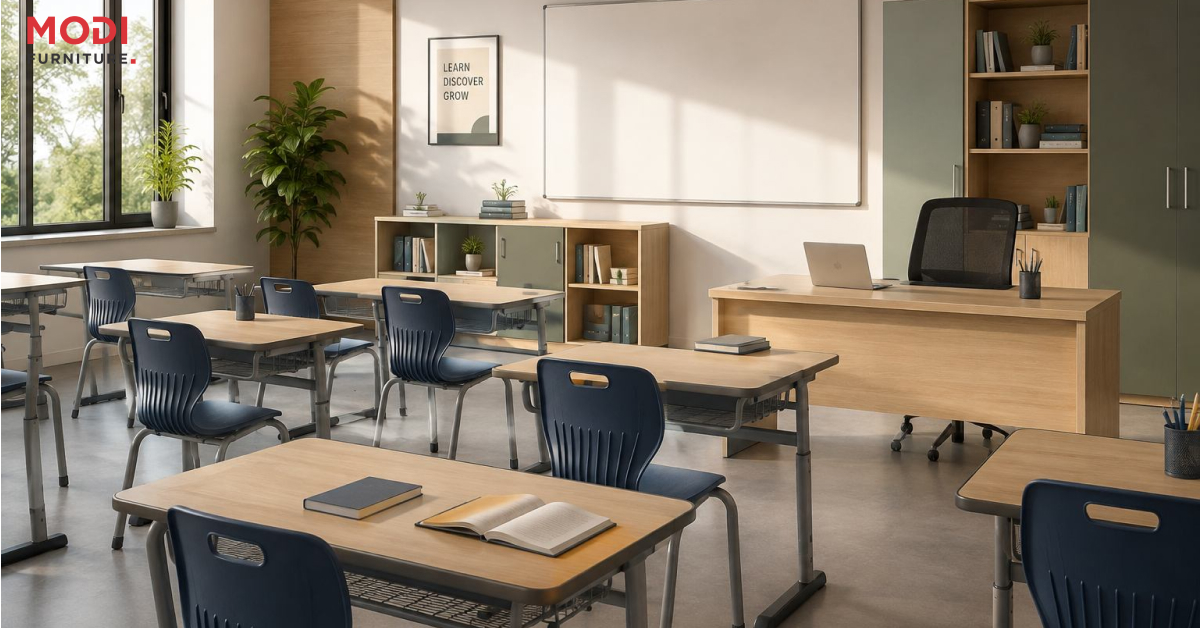
Flexible classroom furniture includes desks, chairs, tables and storage units that can be rearranged more easily than traditional fixed classroom setups.
In a conventional classroom, desks may remain in the same rows throughout the school year. A flexible classroom, however, allows the teacher to change the arrangement when the lesson requires something different.
Typical examples include:
- Modular student desks
- Lightweight movable chairs
- Collaborative tables
- Individual desks that can be joined together
- Mobile or compact storage
- Teacher furniture that does not restrict movement
Schools planning flexible learning spaces should choose furniture that can support different classroom layouts without compromising durability or comfort. Modi Furniture offers a range of classroom furniture including student desks and seating designed for educational spaces.
Why Fixed Classroom Layouts Can Be Limiting
Traditional rows are still useful in many situations. They work well for direct instruction, written work, tests and activities where students need to face the teacher or board.
The limitation appears when the room needs to support group work, discussions or practical activities.
Heavy desks and fixed seating can make rearrangement difficult and time-consuming. Teachers may avoid changing the layout simply because moving the furniture is inconvenient.
This can reduce the classroom's flexibility and make certain activities harder to manage.
A more adaptable setup gives teachers the option to use traditional rows when needed and switch to another arrangement when the lesson benefits from it.
Modular Desks Support Different Learning Activities
Modular desks are one of the most practical elements of modular classroom furniture.
A single desk can work as an individual workstation, but several desks can also be grouped together when students need to collaborate. This means schools do not need separate furniture for every teaching style.
For example, the same desks may be arranged as:
- Individual seating for tests or focused work
- Pairs for partner activities
- Small clusters for project work
- Larger groups for collaborative tasks
- U-shaped layouts for discussions
- Forward-facing rows for lectures
This gives the teacher more control over the room without requiring major changes to the classroom itself.
For schools reviewing overall furniture selection, Modi Furniture’s classroom furniture guide provides additional guidance on comfort, function and classroom use.
Movable Chairs Make Reconfiguration Easier
Flexible desks work best when the chairs are also practical to move.
A chair should be light enough to reposition when needed, but it must still feel stable and durable during normal use. Schools should avoid choosing furniture that is easy to move but too weak for daily classroom use.
Good student chairs should offer a balance between mobility and support. Important factors include suitable height, comfortable back support, stability, easy cleaning and durability.
Age also matters. A chair that works for secondary-school students may not be suitable for younger children.
Schools can compare age-appropriate dimensions using Modi Furniture’s school desk sizes and dimensions guide.
Flexible Furniture Supports Collaborative Learning
Group learning is one of the clearest reasons to use flexible classroom furniture.
When students are working on a shared assignment, discussion or project, forward-facing rows may not be the most practical setup. Modular desks can be moved into clusters so students can face one another and share materials more easily.
This can support activities involving:
- Group discussions
- Project work
- Shared worksheets
- Presentation preparation
- Team problem-solving
- Collaborative digital work
The value comes from being able to move between different layouts without replacing the furniture.
Once group work is complete, desks can return to individual or forward-facing positions.
Better Use of Classroom Space
Flexible furniture can also help schools use the available floor area more efficiently.
Not every classroom is large, and oversized or difficult-to-move furniture can make a small room feel even more restricted.
When desks and chairs are appropriately sized and easy to rearrange, the room can be opened up for different activities.
For example, schools may temporarily create more floor space for:
- Presentations
- Demonstrations
- Classroom activities
- Group discussions
- Practical exercises
- Student performances
The idea is not to move the furniture constantly. It is to make the room adaptable when the activity requires a different setup.
Teacher Movement and Visibility Matter Too
Classroom furniture should support teachers as well as students.
Teachers need to move between desks, observe student work and reach different parts of the room without difficulty. A layout that looks neat but creates narrow pathways can make classroom management harder.
Flexible arrangements can help create clearer movement paths while still giving students enough working space.
Schools should consider whether the teacher can:
- Move between groups comfortably
- Reach students who need assistance
- Maintain visibility across the room
- Access the board and teaching area
- Reach doors and storage without obstruction
Furniture planning should always include these practical details.
Different Lessons Need Different Layouts
One of the main advantages of flexible classroom furniture is that it allows the room to support more than one teaching method.
A lecture-style lesson may require students to face the front. A project may work better with groups. A classroom discussion may need a more open arrangement.
A flexible classroom may therefore switch between:
Lecture Layout
Desks face the teacher or board for direct instruction.
Group Layout
Desks are arranged in clusters for collaborative work.
Discussion Layout
Furniture is arranged in a U-shape or open format to encourage interaction.
Individual Work Layout
Students are seated separately for focused tasks or assessments.
Project Layout
Several desks are combined to create larger shared work surfaces.
The furniture does not determine the teaching method. It simply gives teachers more options.
Flexibility Should Not Come at the Cost of Durability
Furniture in schools is used heavily.
Desks and chairs may be moved, leaned on, cleaned and used by different students every year. If flexible furniture is poorly built, frequent movement can cause damage quickly.
Schools should therefore evaluate more than how easily a desk or chair can be moved.
Important durability factors include:
- Strong frames
- Stable joints
- Durable surfaces
- Smooth edges
- Reliable fittings
- Easy-to-clean materials
- Repairable construction
The best flexible furniture should remain stable even after repeated use and reconfiguration.
Choose Furniture According to Student Age
Student age should remain an important part of the selection process.
Younger children need furniture that matches their height and is easy to use safely. Older students may need larger work surfaces for books, laptops and other learning materials.
That means one furniture size should not automatically be used across the entire school.
A primary classroom may benefit from smaller, lighter pieces, while secondary classrooms may need larger desks and more substantial seating.
Modi Furniture’s existing content on school furniture for children can support schools when planning age-appropriate spaces.
Storage Should Support Flexibility
A classroom can only be flexible if the floor space remains manageable.
Poorly positioned cabinets and storage units can block movement and make reconfiguration difficult. Storage should therefore be planned as part of the classroom layout, not added at the end.
Useful options may include wall-side cabinets, bookshelves, teacher storage and compact units for student materials.
The aim is to keep learning resources accessible without reducing the space available for movement.
Plan the Classroom Before Ordering Furniture
Schools should not select modular desks and chairs before understanding the room they will be used in.
Before ordering furniture, measure the classroom and consider how many students need to be seated, how much movement space is required and what layouts teachers are likely to use.
Important planning points include:
- Classroom dimensions
- Number of students
- Student age group
- Desk and chair size
- Door positions
- Board position
- Storage placement
- Teacher movement space
A simple floor plan can help schools test different seating arrangements before making a bulk purchase.
This is often more useful than choosing furniture only from a catalogue and trying to make it fit later.
When Does Flexible Classroom Furniture Make the Most Sense?
Flexible classroom furniture can be especially useful in schools where classrooms support different activities throughout the day.
It may be a good fit when:
- Group work is common
- Project-based learning is used
- One classroom supports several subjects
- Teachers regularly change seating arrangements
- Space is limited
- Schools want to prepare classrooms for future teaching methods
Not every room needs the same level of flexibility. Some specialized spaces may work better with more permanent layouts.
The furniture strategy should match the purpose of the room.
Flexible Furniture Should Support Learning, Not Distract From It
A flexible classroom does not need to be rearranged every hour.
Constantly moving furniture can become distracting if there is no clear reason for doing it.
The real benefit is having the option to change the room when the lesson requires it.
Teachers can use a traditional arrangement when it works and switch to group or discussion layouts when needed. That makes flexibility practical rather than decorative.
Modi Furniture’s article on how classroom furniture can improve student learning provides broader context on the relationship between classroom design, comfort and learning activities.
Building a More Adaptable Classroom
Modern classrooms need to support listening, writing, discussion, collaboration and independent work.
The furniture should make these activities easier, not limit them.
Flexible classroom furniture allows schools to create spaces that can adapt to different teaching styles without requiring multiple classrooms or multiple sets of furniture.
Modular desks can move between individual and group configurations. Movable chairs make layout changes easier. Well-planned storage keeps the room organized, while suitable dimensions help maintain student comfort.
For schools planning new classrooms or upgrading existing learning spaces, Modi Furniture offers educational and institutional furniture options designed for different school environments.
The best flexible classroom is not the one where the furniture moves the most. It is the one where teachers and students can use the space in the way that best supports the activity taking place.
FAQs
What is flexible classroom furniture?
Flexible classroom furniture includes desks, chairs, tables and storage that can be rearranged to support different learning activities and classroom layouts.
What are modular classroom desks?
Modular desks are desks that can be used individually or combined with other desks to create group, discussion or collaborative layouts.
Is flexible classroom furniture suitable for primary students?
Yes, provided the desks and chairs are appropriately sized, stable and suitable for the age group using them.
What should schools check before buying flexible classroom furniture?
Schools should consider room size, number of students, furniture dimensions, durability, stability, ease of movement and the types of layouts teachers need.
Can flexible classroom furniture be used in small classrooms?
Yes. Appropriately sized modular furniture can help smaller classrooms support different activities more efficiently.
Does flexible furniture replace traditional classroom layouts?
No. It allows schools to use traditional rows when needed while also making group, discussion and project-based layouts easier to create.
-

How to Furnish a Complete School: Classroom, Library, Lab, Staff Room & Reception
September 25th, 2026 -

How to Maintain School Furniture: Cleaning, Care & Repair Tips for Longer Life
September 24th, 2026 -
 September 23rd, 2026
 -

School Furniture Checklist: Everything Needed for a Modern School
September 16th, 2026 -
Classroom Furniture Guide: Choosing the Right Furniture for Schools
September 2nd, 2026