

How to Furnish a Complete School: Classroom, Library, Lab, Staff Room & Reception
Furnishing a school is very different from buying a few desks and chairs for classrooms. A complete school includes multiple spaces, and each one serves a different purpose.
Students need comfortable classroom furniture for daily learning. Libraries need quiet study areas and organized storage. Laboratories require work surfaces designed around practical activities. Staff rooms need functional furniture for teachers, while reception areas create the first impression for parents and visitors.
Because these spaces have different requirements, a school furniture plan should be developed area by area rather than using the same furniture everywhere.
A well-planned school environment can improve space utilization, support daily activities and make furniture easier to maintain over the long term.
Start With a Complete School Furniture Plan
Before placing a bulk furniture order, schools should first identify every area that needs to be furnished.
A typical school may include:
- Classrooms
- Library
- Science laboratory
- Computer lab
- Staff room
- Reception and administration
- Principal’s office
- Storage areas
- Activity rooms
- Multipurpose spaces
The next step is to estimate how many people will use each space and what activities will take place there.
This prevents two common problems: ordering furniture that does not fit the room properly and buying products that do not suit the way the space will actually be used.
Modi Furniture’s existing guide on institutional furniture also highlights the importance of evaluating space, durability and usability before making large furniture purchases.
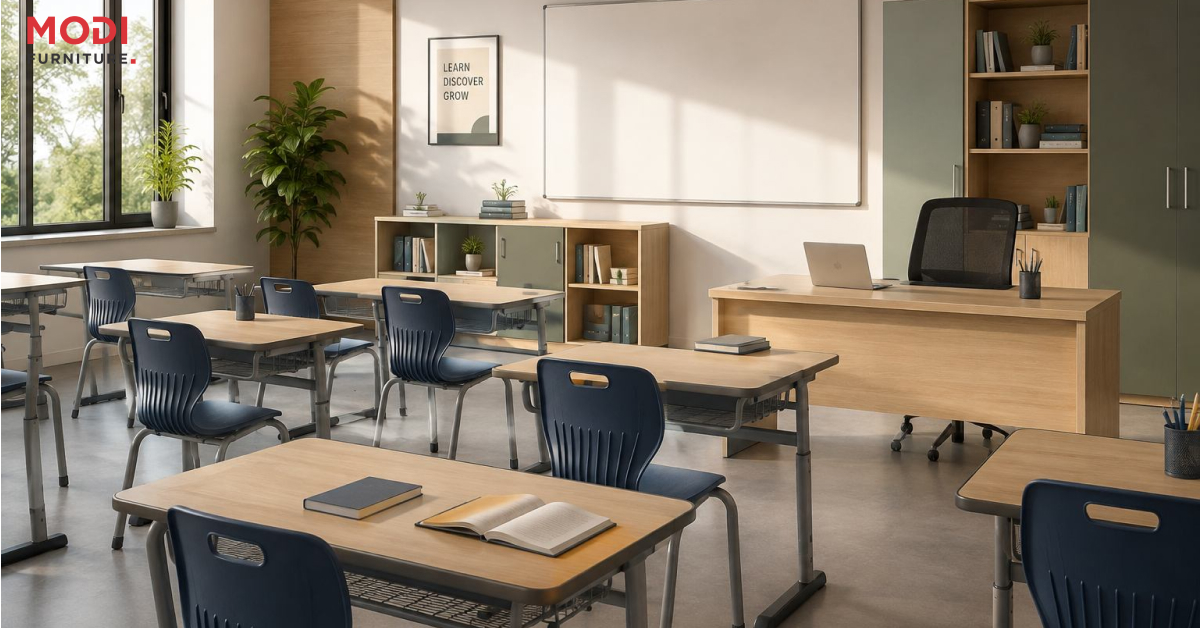
1. Classroom Furniture: Build Around Everyday Learning
Classrooms usually require the largest quantity of furniture in a school, so this area needs careful planning.
The basic setup generally includes:
- Student desks
- Student chairs or bench-desk combinations
- Teacher table
- Teacher chair
- Storage cabinets
- Bookshelves or classroom storage
- Display or activity furniture where needed
The most important factor is selecting furniture according to the age and size of the students.
Furniture that is too high or too low can make sitting and writing uncomfortable. This is especially important when a school has students from primary through senior classes.
Schools planning or upgrading learning spaces can explore Modi Furniture’s classroom furniture range for student desks, seating and other furniture designed for educational environments.
Modi Furniture’s school desk sizes and dimensions guide provides more detail on selecting desk sizes for different student age groups.
Think About Classroom Layout Too
Furniture should fit the room without making movement difficult.
Schools should leave enough space for:
- Students to enter and leave seats
- Teachers to move between rows
- Access to doors
- Movement around storage areas
- Changes in seating layout when required
2. Library Furniture: Balance Reading, Storage and Quiet Study
A school library requires more than bookshelves.
The furniture should support reading, research, group study and book organization without making the room feel crowded.
A complete library setup may include:
- Book racks
- Reading tables
- Student chairs
- Librarian desk
- Storage cabinets
- Magazine or display racks
- Computer tables where digital access is provided
Book storage should be easy to access and arranged according to the age group using the library.
Younger students may benefit from lower shelving, while secondary-school libraries can use taller storage systems where appropriate.
Reading tables should also allow students enough personal space to use books, notebooks and study materials comfortably.
Modi Furniture already covers this area in its guide to library furniture for comfort and organization.
3. Laboratory Furniture: Plan Around the Activity
Laboratory furniture should be selected according to the subject and type of practical work performed.
A science lab may require:
- Laboratory work tables
- Stools
- Teacher demonstration table
- Storage cabinets
- Equipment storage
- Work surfaces appropriate for laboratory use
Unlike general classroom furniture, laboratory furniture needs to accommodate practical activity as well as seating.
Schools should consider:
- Work surface size
- Ease of movement
- Equipment placement
- Storage requirements
- Cleaning needs
- Number of students using each workstation
Different science subjects may also have different furniture requirements.
Schools setting up or upgrading science labs can explore Modi Furniture’s laboratory furniture range for work tables, seating and storage solutions designed for educational laboratory environments.
Schools should also consider work surface size, equipment placement, cleaning requirements, storage capacity and the number of students using each workstation.
For more detailed information on individual furniture types, see Modi Furniture’s types of laboratory furniture guide.
4. Computer Lab Furniture: Make Space for Equipment and Students
Computer labs require furniture that supports both the student and the equipment.
A crowded computer table can make cable management, monitor placement and student movement difficult.
A practical computer lab usually needs:
- Computer tables
- Student chairs
- Teacher workstation
- Equipment storage
- Cable-management provisions
- Space for maintenance access
Table depth is especially important because the student needs sufficient space between the screen and seating position while still having room for a keyboard and other learning materials.
The layout should also make it possible for teachers to move between students and monitor the room.
Schools planning or upgrading a digital learning area can refer to Modi Furniture’s existing computer lab design guide.
5. Staff Room Furniture: Create a Functional Working Space for Teachers
The staff room is used differently from student areas.
Teachers may use it for lesson preparation, paperwork, short meetings, storage and breaks between classes.
Useful staff-room furniture can include:
- Work tables
- Comfortable chairs
- Individual storage
- Filing cabinets
- Bookshelves
- Meeting table
- Shared storage cabinets
The number of teachers should determine the layout.
If several teachers work in the room at the same time, large shared tables or grouped workstations may use the available space more efficiently than separate oversized desks.
Storage is particularly important because teachers often need space for books, documents, teaching material and personal belongings.
6. Reception and Administration Areas
The reception area is often the first indoor space seen by parents, visitors and new students. Its furniture should therefore balance function and presentation.
A school reception may require:
- Reception desk
- Staff chair
- Visitor chairs
- Waiting-area seating
- Storage cabinets
- Filing units
The reception desk should provide enough working space for computers, documents and visitor management without making the entrance feel blocked.
Waiting furniture should also be arranged so that visitors can sit comfortably without interfering with staff movement.
Administrative areas may additionally need workstations, executive desks, meeting tables and document storage.
7. Principal’s Office and Meeting Areas
The principal’s office generally serves several purposes.
It may be used for individual work, discussions with teachers, meetings with parents and administrative decision-making.
Furniture may include:
- Executive desk
- Office chair
- Visitor chairs
- Storage cabinets
- Small meeting table
- Bookshelf or display storage
The room should feel professional while still remaining practical for daily school administration.
Schools should avoid filling the room with oversized furniture that leaves too little usable space.
8. Storage Furniture Across the School
Storage is often underestimated during school furniture planning.
Without enough storage, books, teaching material, records, sports items and supplies can quickly make classrooms and staff spaces disorganized.
Different areas may require different solutions:
- Classrooms: bookshelves and cabinets
- Library: book racks and closed storage
- Laboratory: equipment cabinets
- Staff room: personal and document storage
- Administration: filing cabinets and cupboards
Instead of adding storage only after the school becomes operational, it is better to include it in the original furniture plan.
9. Choose Furniture for Long-Term School Use
School furniture is used repeatedly every working day, so purchase decisions should consider long-term use rather than appearance alone.
Schools should evaluate:
- Construction quality
- Stability
- Materials
- Surface finish
- Ease of cleaning
- Repairability
- Storage efficiency
- Suitability for student age
- Ability to handle frequent daily use
Furniture should also be easy to maintain because replacing large quantities of school desks, chairs or storage units frequently can become expensive.
10. Keep the Design Consistent, but Not Identical
A school can maintain a consistent visual identity without using exactly the same furniture everywhere.
For example, similar finishes or colour themes can be used across classrooms, the library and staff areas while the furniture design changes according to each room’s function.
This approach creates a more coordinated environment while allowing each area to remain practical.
A laboratory table does not need to look like a classroom desk. A reception desk does not need to match a library table exactly.
Function should always come first.
Plan the Complete School, Not Just the Classroom
Successful school furniture planning means looking beyond desks and chairs.
Every space has a role in the learning environment.
Classrooms support teaching. Libraries support reading and research. Laboratories support practical learning. Staff rooms give teachers a functional workspace. Reception and administration areas support communication and daily school management.
By planning each area separately and then bringing everything together under one furniture strategy, schools can make better use of space and avoid unnecessary purchasing mistakes.
For institutions planning a new campus or upgrading an existing one, working with a supplier that understands different educational spaces can make bulk planning simpler.
Modi Furniture offers furniture solutions for educational and institutional environments, including classrooms, laboratories, libraries, computer labs, staff areas and administrative spaces.
The best school furniture plan is not the one with the most furniture. It is the one where every table, chair, cabinet and workstation has a clear purpose in the space where it is used.
FAQs
What furniture is needed for a complete school?
A complete school may require classroom desks and chairs, teacher furniture, library tables and shelving, laboratory furniture, computer lab tables, staff-room furniture, reception furniture and storage units.
How should schools choose classroom furniture?
Schools should consider student age, furniture dimensions, classroom size, daily use, durability and the amount of movement required inside the classroom.
What furniture is required in a school library?
Typical library furniture includes book racks, reading tables, chairs, librarian furniture, storage cabinets and, where required, computer workstations.
Is laboratory furniture different from classroom furniture?
Yes. Laboratory furniture needs to support practical work, equipment placement, storage and easier cleaning, while general classroom furniture is mainly designed around seating, writing and learning.
What should be included in a school staff room?
A staff room may include work tables, comfortable chairs, storage cabinets, filing units, bookshelves and shared meeting furniture.
Why is furniture planning important before placing a bulk school order?
Planning helps schools select the correct quantities, dimensions and furniture types for each room, reducing the risk of overcrowding, unused furniture or unsuitable products.
-

Flexible Classroom Furniture: How Modular Desks and Chairs Support Modern Learning
September 26th, 2026 -

How to Maintain School Furniture: Cleaning, Care & Repair Tips for Longer Life
September 24th, 2026 -
 September 23rd, 2026
 -

School Furniture Checklist: Everything Needed for a Modern School
September 16th, 2026 -
Classroom Furniture Guide: Choosing the Right Furniture for Schools
September 2nd, 2026